
The Epicurean Paradox: Why the Problem of Evil Still Matters
- XSite Bunny

- Dec 18, 2025
- 3 min read
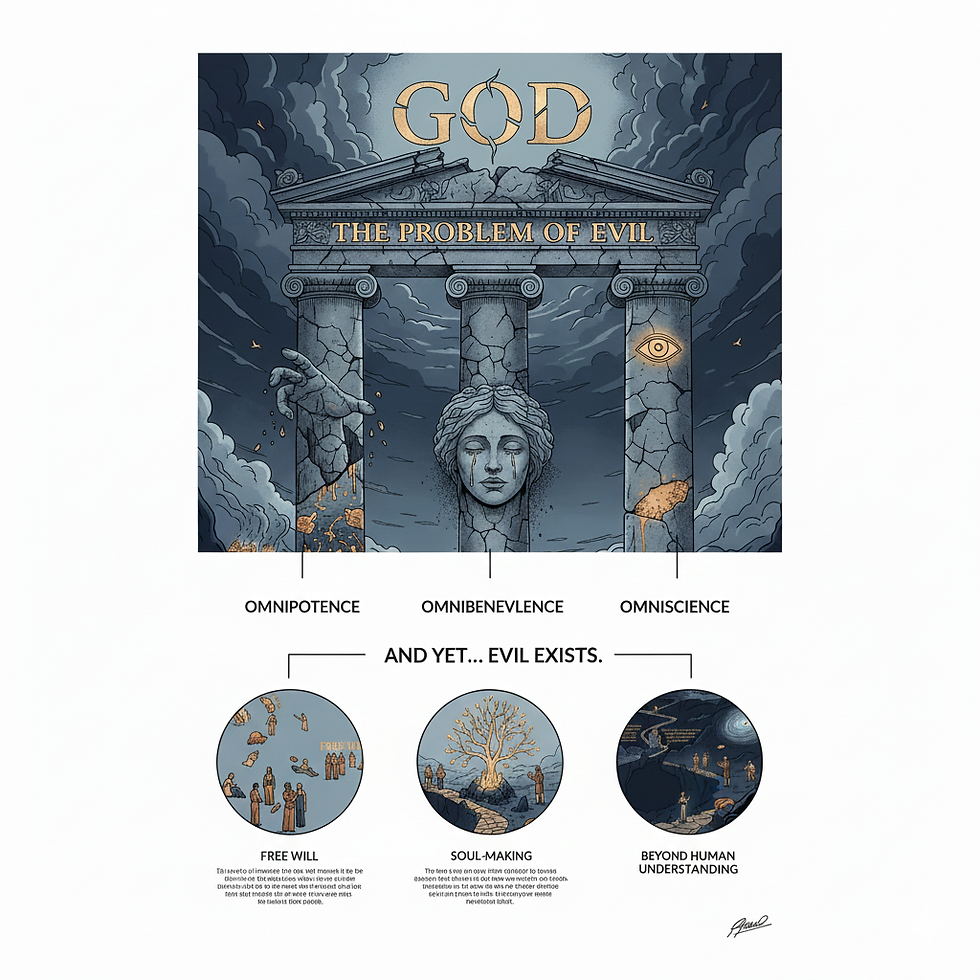
The Epicurean Paradox is one of the oldest and most enduring challenges to classical theism. Attributed to the Greek philosopher Epicurus (341–270 BCE), the paradox confronts a fundamental tension between the existence of evil and the belief in an all-powerful, all-knowing, and all-good God. Despite its ancient origins, the paradox remains highly relevant because it strikes at the logical foundation of how many people conceptualize divine authority, morality, and suffering.
The Paradox Explained
The paradox is commonly summarized in four propositions:
1. If God is willing to prevent evil but not able, then God is not omnipotent.
2. If God is able to prevent evil but not willing, then God is not omnibenevolent.
3. If God is both able and willing to prevent evil, then why does evil exist?
4. If God is neither able nor willing, then why call God “God”?
The force of the paradox lies in its simplicity. It does not rely on emotional appeals or anecdotal suffering; it is a logical critique. If all four divine attributes omniscience, omnipotence, omnibenevolence, and omnipresence are simultaneously true, then the persistent existence of suffering, injustice, and gratuitous evil appears contradictory.
Logical vs. Evidential Evil
Philosophers typically divide the problem of evil into two categories:
• The Logical Problem of Evil argues that the coexistence of God and evil is logically impossible.
• The Evidential Problem of Evil argues that while coexistence may be logically possible, the amount and nature of evil in the world make God’s existence improbable.
Epicurus is primarily associated with the logical problem, though modern philosophers often focus more on the evidential version. Natural disasters, childhood diseases, genocides, and seemingly pointless suffering raise the question: even if some evil serves a purpose, why does so much appear unnecessary?
Common Theistic Responses and Their Weaknesses
Several defenses are routinely offered to resolve the paradox, but each comes with costs.
Free Will Defense
This argument claims that God allows evil because free will is a greater good. However, this fails to account for natural evil such as earthquakes or pandemics and raises a deeper issue: could an omnipotent God not create free beings who freely choose good more consistently?
Soul-Making Theodicy
Here, suffering is framed as necessary for moral and spiritual growth. The problem is proportionality. Extreme and indiscriminate suffering especially inflicted on children far exceeds what is required for moral development.
God’s Ways Are Beyond Human Understanding
This response abandons rational theology entirely. If divine morality is inaccessible, then moral claims about God being good become meaningless. A goodness that cannot be evaluated is not goodness in any coherent sense.
Why the Paradox Still Holds Weight
The Epicurean Paradox remains compelling because it exposes a fundamental inconsistency in classical definitions of God, not necessarily in spirituality itself. The paradox does not disprove all conceptions of divinity, but it seriously undermines the tri-omni God of traditional Western theology.
Many modern thinkers resolve this tension not by defeating the paradox, but by revising the concept of God—limiting omnipotence, redefining goodness, or interpreting God as a process rather than an absolute ruler. These moves may preserve faith, but they concede the paradox’s core critique.
Conclusion
The Epicurean Paradox endures because it is not merely a question about God; it is a question about intellectual honesty. Either evil exists for reasons that force us to rethink divine attributes, or we accept that traditional theology contains unresolved contradictions.
In either case, the paradox succeeds in what all great philosophy aims to do: it forces clarity. And clarity, even when uncomfortable, is preferable to belief sustained by avoidance.


Comments